
Why areas make sense when you eat away from home
Nobody picks dinner from every restaurant on earth. You pick from the street you are standing on.
The Idea
Sorted by where you are standing
Food is local, and so is the choice of where to eat: this street, this town, this stop on the trip. So every menu on My Menu Area sits under the area its restaurant is in, and opening an area shows the places we have menus for, each one a tap away from its full card.
Areas fill in slowly and on purpose, as owners send their menus and guests tell us about places worth adding. Once a page is up, the people who run the restaurant keep it current with us.
One Card, Start to Finish
What happens to a salads page
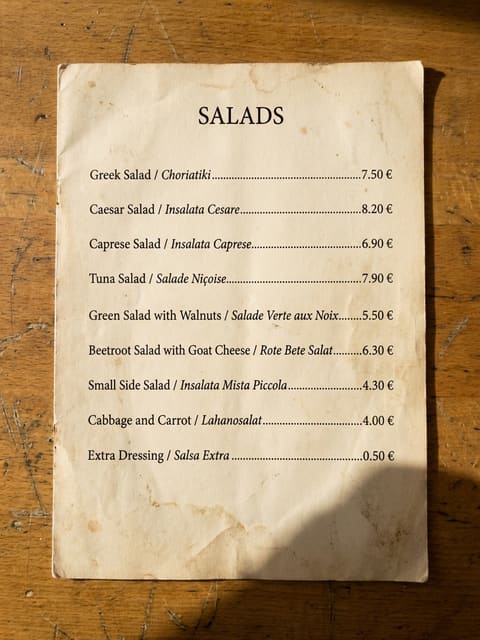
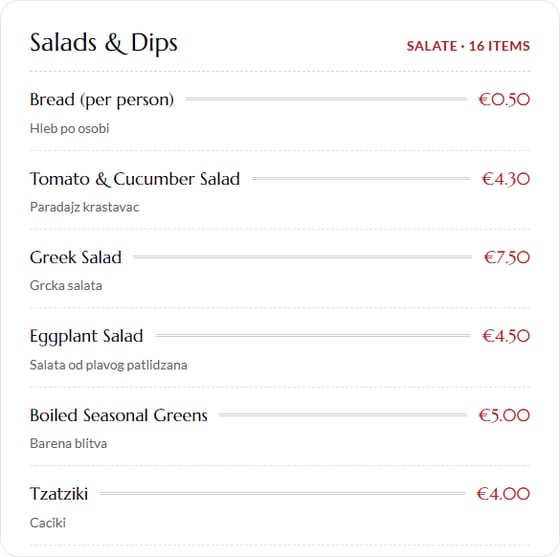
A printed salads page carries the dish, the name the kitchen uses and the price, and little else. One edition of the menu at The Captain Restaurant - Tavern prints each dish in Serbian with English underneath, and this is what its salads became on the site.
From paper to page
Every page of a card comes in, drinks and desserts included, together with the restaurant's address, phone number, hours and a few photos. Each line is typed with its price and its unit as printed: the bread stays at €0.50 per person, sea bass stays priced by the kilo, and the house wine stays in half liters and liters.
The sections keep the restaurant's own order. Each dish gets a plain English name, and the name printed on the card stays right under it, so Hleb po osobi is still there when you point at the bread line.
Before a page goes up, the prices are read back against the photos, and the hours, map pin and phone number against the restaurant's own listing. The printed pages then go onto the menu page in its Menu Gallery, and every correction an owner or a guest sends goes in whenever it reaches us.
How a card reaches us
Owners send their current menu, hours and photos, and those pages are the easiest to keep exact, because the people who set the prices tell us when they change. Many good places never put a menu online at all; for them, a clear photo of the printed card is enough for us to type it. Addresses, opening hours, map locations and service details come from the restaurant's own website and its public business listings.
Light enough for a weak signal
Menu pages carry no pop-ups and no heavy scripts, so they open quickly on hotel wifi or on one bar of signal down at the harbor.
Seen a card that has changed since we typed it? Tell us which page and what you saw, and we will fix it.